Race Analysis: How Mikkel Lee Powered to SEA Games Gold in the Men’s 100m Freestyle
A technical look at Singapore’s newest sprint champion — SEA Games 2025, Thailand

Credit: The Straits Times
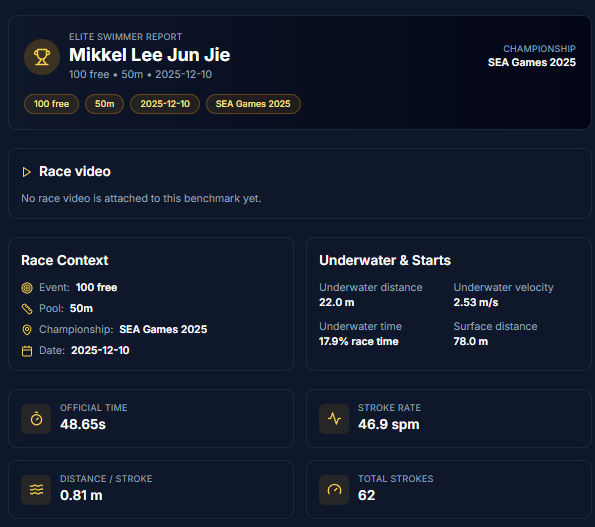
Singapore’s newest sprint star delivered on the biggest stage in Thailand, with Mikkel Lee Jun Jie winning the men’s 100 m freestyle at the 2025 SEA Games in 48.65 to secure gold and underline his status as a true regional force in the blue-riband event. In a final where every swimmer dipped under 51 seconds, Mikkel’s control on the back 50 separated him from both his more established teammate Quah Zheng Wen and a hungry Vietnamese contingent led by Tran Van Nguyen Quoc, who pushed the podium all the way to the wall.
Swim speed: how fast he moved
The race opens with a world-class burst: Start to Breakout (15.0 m) in 5.05 s at 2.97 m/s, the fastest water he sees all race and the clear velocity ceiling for the day. From there, speed settles to 2.00 m/s between Breakout and 25 m and 1.92 m/s over L1: 25–50 m, giving him a stable first-50 profile after the explosive launch.
After the turn, the engine really shows: Breakout to 75 m is covered in 8.05 s at 2.24 m/s, his best sustained race-pace segment and effectively the “center” of the performance. The final L2: 75–100 m eases to 13.90 s at 1.80 m/s, roughly 39.5% down from his 2.97 m/s peak, but still quick enough to convert the earlier speed into a winning margin with form intact.

Stroke rate: how fast he cycled
Across the full 100 m, Mikkel averages 46.9 spm, but the segment breakdown shows a deliberate pattern rather than random fluctuation. After the no-stroke Start to Breakout phase, he spins up to 50.8 spm from Breakout to 25 m, then eases slightly to 47.8 spm on L1: 25–50 m as he shifts from acceleration into controlled cruising.
On the second 50 m, stroke rate tightens and drops only gently: 45.4 spm from Breakout to 75 m and 44.8 spm across L2: 75–100 m. That shallow decline in tempo — instead of a steep collapse — is a major reason his 25.50 closing split looks composed and why he can hold connection while others are fading.

Distance per stroke: how well he held water
Efficiency is where this race quietly becomes elite. From Breakout to 25 m, he sits at 1.11 m per stroke at 50.8 spm, using higher rate to lock in pace straight after the underwater. Then the stroke lengthens: L1: 25–50 m stretches to 1.32 m per stroke at 47.8 spm, a classic championship balance of long strokes and moderate tempo on the first length.
The best blend of stroke length and speed arrives from Breakout to 75 m, where he reaches 1.38 m per stroke at 45.4 spm while travelling at 2.24 m/s — the most efficient clean-swimming window of the race. Even in the closing L2: 75–100 m, distance per stroke compresses only to 1.19 m at 44.8 spm, indicating a controlled shortening rather than technical breakdown, which aligns with how steady his 25.50 back-half appears.

Why this race works for Mikkel
Put together, the numbers describe a 100 m free that is brilliantly structured for championship pressure. An elite 2.97 m/s start and 22.0 m of underwater give him early speed without overspinning; a mid-race band of 1.92–2.24 m/s with DPS in the 1.32–1.38 m range shows genuine world-class efficiency; and a closing 1.80 m/s segment with stable stroke rate proves he can absorb fatigue without losing form. For Singapore, that combination of speed, stroke quality, and race intelligence is exactly what you want in a new sprint leader — and for Mikkel, it sets a solid platform to chase even faster times off the same race blueprint.
How can we help?
SwimInsights is designed to unpack races like this in the same way for any competitive swimmer — from segment-by-segment speed, stroke rate and distance per stroke, to underwater usage and overall efficiency patterns. If you would like a similar race report done for your own performance or for your swimmers, you can submit your race details and video through SwimInsights to receive a structured breakdown, clear visuals, and coach-ready insights tailored to your event.
If you would like a similar in-depth report for your own race or for your squad, get in touch with SwimInsights to submit your race and receive a structured, data-driven analysis you can immediately turn into smarter training and faster swims


Comments