Pure Sprint Execution: How Teong Tzen Wei Took Gold in the Men's 50m Butterfly at SEA Games 2025

Pic Credit Straits Times
The Men's 50m Butterfly final at the 2025 SEA Games came down to raw speed, precision, and execution — and Tzen Wei Teong delivered all three when it mattered most.
Touching first in 23.24, Teong claimed Gold for Singapore, holding off a tightly packed field in one of the most explosive races of the meet. In a discipline where margins are measured in hundredths, his ability to combine a clean start with controlled acceleration proved decisive.
From the dive, Teong established momentum immediately. His reaction time of +0.54 was among the best in the final, allowing him to surface cleanly and carry speed through the mid-pool phase. While several swimmers surged late, Teong's stroke stability and line into the wall ensured he stayed just ahead all the way to the finish.
Teammate Zheng Wen Quah pushed hard for silver, finishing in 23.57, securing yet another Singapore podium double. The Philippines' Logan Wataru Noguchi rounded out the medals with a strong 23.97, while the rest of the field finished within just 1.7 seconds — a clear sign of the rising sprint butterfly standard across Southeast Asia.
This was not a flashy win — it was a technically efficient, mistake-free sprint, and that is exactly why Teong Tzen Wei stood on the top step of the podium.

Swim speed: how fast he moved
The race opens with explosive power: Start to Breakout (15.0 m) in 4.61 s at 3.26 m/s — world-class underwater velocity that sets the foundation for everything that follows. That opening surge is the velocity ceiling for the race, and it's where Teong establishes his winning position before the field even reaches the surface.
After breakout, the swim becomes a study in controlled aggression. The initial Breakout to 15m segment is just 0.10 s with 1 stroke — essentially immediate acceleration into surface swimming at 600.0 spm momentary rate as he transitions from underwater to rhythm.
The mid-race tempo settles into sprint mode: 2.23 m/s over 15m-25m with 4 strokes at 63.3 spm, then 1.82 m/s through 25m-35m with 7 strokes at 66.8 spm. The closing 35m-50m holds at 1.75 m/s over 8.56 s with 9 strokes at 65.1 spm — roughly 46% down from his 3.26 m/s peak — but still quick enough to protect the lead and touch first with authority.

Stroke rate: how fast he cycled
Across the full 50 m, Teong averages 32.7 spm — butterfly sprint tempo that balances power application with forward momentum. But the segment pattern reveals where the race strategy lives.
After the no-stroke underwater phase, he explodes into transition mode with that momentary 600.0 spm burst (essentially one stroke in 0.10 seconds) from Breakout to 15m — pure acceleration to lock in surface speed.
The tempo then stabilizes through the sprint phases: 63.3 spm over 15m-25m (4 strokes), 66.8 spm from 25m-35m (7 strokes), and 65.1 spm over the final 35m-50m (9 strokes). That narrow band of 63-67 spm shows controlled, consistent turnover — no panic, no collapse, just steady rhythm maintenance all the way to the wall.

Distance per stroke: how well he held water
Efficiency in a 50 fly sprint is about maximizing propulsion while maintaining rate. Teong's numbers tell that story perfectly.
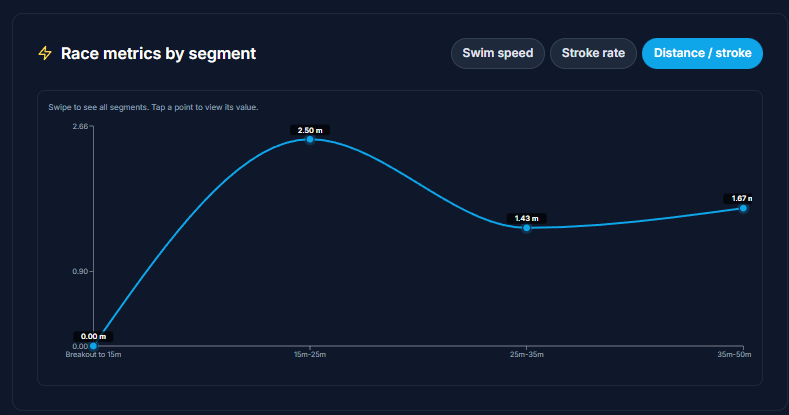
The initial transition stroke from Breakout to 15m shows 0.00 m DPS (categorized as pure acceleration), then the stroke pattern develops: 2.50 m per stroke at 63.3 spm over 15m-25m — his longest, most efficient strokes of the race, capitalizing on momentum from the explosive start.
As the race progresses, distance per stroke compresses strategically: 1.43 m DPS at 66.8 spm (25m-35m) and 1.67 m DPS at 65.1 spm (35m-50m). That compression isn't breakdown — it's the natural trade-off between maintaining rate and holding connection as lactate builds. The overall average of 2.38 m DPS across just 21 total strokes reflects maximum efficiency: not many strokes, but each one powerful and purposeful.
Why this race works for Teong
Taken together, the numbers describe a 50 m butterfly brilliantly executed for gold-medal sprinting. An explosive 3.26 m/s underwater covering 15.0 m (19.8% of race time) establishes dominance from the gun; a seamless transition at breakout maintains momentum; and a controlled 1.75-2.23 m/s mid-race band with consistent 63-67 spm tempo allows him to protect speed all the way to the wall.
For Singapore, that combination of explosive starts, technical precision, and sustained sprint mechanics is exactly what you want from an elite 50 flyer — and for Teong Tzen Wei, it provides a robust blueprint to chase even faster times off the same race model.
The 23.24 wasn't just a gold medal — it was a technical masterpiece that showcased what happens when underwater dominance, stroke efficiency, and mental composure align perfectly in the sport's most explosive butterfly sprint.
How can we help?
SwimInsights is designed to unpack races like this in the same way for any competitive swimmer — from segment-by-segment speed, stroke rate and distance per stroke, to underwater usage and overall efficiency patterns. If you would like a similar race report for your own performance or for your swimmers, you can submit race details and video through SwimInsights to receive a structured breakdown, clear visuals, and coach-ready insights tailored to your event.
If you would like a similar in-depth report for your own race or for your squad, get in touch with SwimInsights to submit your race and receive a structured, data-driven analysis you can immediately turn into smarter training and faster swims.


Comments